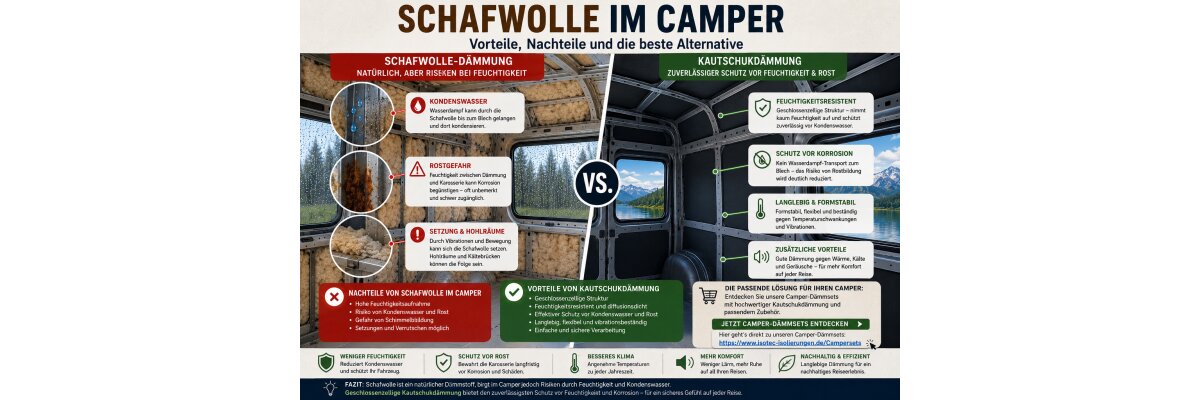
Anyone who fits out their own camper will sooner or later deal with the right insulation. In addition to classic materials like Armaflex, Kaiflex, or K-Flex, sheep's wool is also frequently mentioned as a natural alternative. After all, it is a renewable raw material with good insulating properties and a positive environmental footprint.
But is sheep's wool really suitable for insulating a camper or motorhome? While it certainly has its advantages in house construction, different physical conditions apply to vehicle manufacturing. Condensation, extreme temperature fluctuations, and the closed metal body present very special challenges for the material.
In this article, you will learn about the advantages and disadvantages of sheep's wool in a camper and which alternatives have truly proven themselves in practice.
📌 The Most Important Points at a Glance
-
🌱 Ecological Approach: Sheep's wool is a natural and sustainable insulation material.
-
💧 Condensation Risk: The dense metal body of a camper promotes the formation of moisture.
-
⚠️ Moisture Reservoir: Sheep's wool absorbs water, which can cause long-term problems in vehicle construction.
-
📉 Vibration Effect: Due to constant vibrations while driving, loose insulation wool can sag over time.
-
🛠️ The Industry Standard: Closed-cell elastomer foam insulation (Armaflex, Kaiflex, K-Flex) is considered absolutely moisture-resistant.
🔍 Why Insulation in a Camper is So Important
A camper consists mostly of sheet metal. Unlike a house, there are no solid walls to cushion temperature fluctuations. In summer, the vehicle body heats up extremely, while in winter, it conducts the cold directly inside.
In addition, moisture is constantly generated in the interior by:
-
💨 The breathing of the occupants while sleeping
-
🍳 Cooking without strong ventilation
-
🚿 Showering in a tight space
-
👟 Wet clothes or gear
When this warm, humid air hits the cold metal of the vehicle body, condensation forms. This is exactly where the real challenge for any camper insulation begins.
👍 What Advantages Does Sheep's Wool Offer in a Camper?
Sheep's wool is a popular natural insulation material for good reason and brings along some very interesting properties:
-
Sustainable Raw Material: Sheep's wool grows back naturally and is one of the most ecological insulation materials on the market. Anyone looking to reduce the plastic content in their vehicle often turns to this option.
-
Good Insulation Performance: With a thermal conductivity of about $0.035$ to $0.040\ \text{W/(m·K)}$, sheep's wool achieves similarly good insulation values as synthetic alternatives.
-
Pleasant Processing: Compared to glass or rock wool, sheep's wool can be cut and installed completely without unpleasant fibers, dust, or itching.
-
Moisture Regulation: It can absorb and temporarily store moisture, which helps buffer peaks in openly designed house walls.
👎 What Are the Disadvantages of Sheep's Wool in a Camper?
The extreme conditions in a closed vehicle body unfortunately often cause the typical advantages of natural fibers to turn into the exact opposite:
-
🌊 Moisture Migrates to the Outer Panels: Sheep's wool is completely vapor-permeable. Water vapor migrates unhindered through the wool to the cold outer sheet metal and condenses there. The water then sits unnoticed behind the paneling.
-
⚙️ Increased Risk of Corrosion (Rust): If moisture remains trapped between the wool and the metal sheet for a long time, it promotes the formation of rust—often invisibly until the damage is already severe.
-
🛑 Limited Drying Potential: While buildings can "breathe," the metal body traps the moisture inside. Adequate drying of the wet wool is hardly possible in a camper.
-
📉 Settling Due to Vibrations: A vehicle is permanently in motion. In the case of loose insulation wool, the vibrations cause it to sag downwards over time. This creates dangerous voids and thermal bridges.
📊 Sheep's Wool vs. Elastomer Foam Insulation: A Direct Comparison
Experienced camper builders primarily rely on closed-cell elastomer foam insulation materials that were specifically developed for areas with high condensation loads.
| Feature | 🐑 Sheep's Wool | 🟦 Elastomer Foam Insulation (e.g., Armaflex) |
| Material Type | Natural fiber | Closed-cell elastomer foam |
| Moisture Absorption | High (soaks up water) | Very low (water beads off) |
| Vapor Diffusion | Open (permeable) | Vapor-tight (integrated vapor barrier) |
| Condensation Risk | Higher | Significantly reduced |
| Long-Term Stability | Medium (can sag) | High (dimensionally stable & self-adhesive) |
| Processing | Laying in or stuffing | Full-surface, void-free gluing |
🛠️ Why Many Camper Builders Rely on Elastomer Foam
Anyone wanting to protect their vehicle from moisture and rust over the long term reaches for closed-cell materials. The best-known and most proven products on the market are Armaflex, Kaiflex, and K-Flex.
These high-performance materials have been used for decades in air conditioning, vehicle, and industrial engineering. Due to their closed-cell structure, they absorb virtually no moisture and reliably prevent humid indoor air from reaching the body panels in the first place.
💡 Tip for the build: Many DIY builders specifically look for a high-quality Armaflex alternative. Alongside the market leader, Kaiflex and K-Flex offer absolutely equivalent properties regarding insulation performance, flexibility, and moisture protection.
To make the build as easy as possible, you will find specially curated camper insulation sets in our shop, which already contain the appropriate insulation thicknesses and the necessary accessories.
Proper installation is crucial for success: The material must be glued directly onto the sheet metal over its entire surface, cleanly, and absolutely free of voids.
💡 Top Tips for a Long-Lasting Camper Insulation
-
🧼 Clean the Surface Thoroughly: The sheet metal must be absolutely clean, dry, and free of grease before gluing so that the adhesive lasts a lifetime.
-
🛡️ Treat Rust Spots Upfront: Existing surface rust must be completely removed, primed, and professionally sealed before insulating.
-
📐 Minimize Thermal Bridges: Insulate deep beams, struts, and metallic transitions carefully using thinner sheets.
-
💨 Ensure Adequate Ventilation: The best insulation cannot replace airing things out. Roof hatches or open windows effectively transport excess moisture outside.
📋 Conclusion
In short: Sheep's wool is an appealing, sustainable insulation material for house construction—but in a camper, its open structure introduces significant moisture and corrosion risks. If you want to play it safe and protect your vehicle permanently, you are almost always much better off with a closed-cell elastomer foam insulation (Armaflex, Kaiflex, or K-Flex).
❓ Frequently Asked Questions (FAQ)
Is sheep's wool suitable for camper conversions?
Generally yes, but due to the risk of condensation on cold sheet metal, it requires an extreme amount of attention and is at a disadvantage inside a vehicle when it comes to moisture control.
Can sheep's wool get moldy in a motorhome?
Yes. If the wool remains damp for a long time and cannot dry out completely, there is a risk of mold formation and unpleasant odors.
What insulation is standardly used in campers?
The absolute majority of DIY builders and professionals use closed-cell elastomer foam (rubber foam) such as Armaflex, Kaiflex, or K-Flex.
What is a good alternative to Armaflex?
The best-known and qualitatively equivalent alternatives are Kaiflex and K-Flex. Both offer excellent moisture protection and identical insulation values.
Which insulation thickness makes sense for a camper?
For large outer surfaces (side walls, roof), 19 mm has established itself as the standard. For beams, curves, and hard-to-reach areas, more flexible, thinner thicknesses (6 mm or 9 mm) are mostly used.